Friday, September 16, 2016

Quail Hollow heat.

This late morning was for the bugs.  With this mid-September day's temperatures reaching the low 80's, I decided to keep my head down.  Pollinators were everywhere down at the grasslands around the pond. So, Violet-green Swallows were also in abundance, among others. I enjoyed a Santa Cruz County Vaux's Swift as well.

Regardless, plenty of butterflies out in the coyote brush, grasses, thistle, and sedge.  The following photographs captured a few common species to be expected late-summer into September/fall in this particular ecotype. 

Plenty of fresh, adult skipper species (family Hesperiidae).
Umber Skipper (Poanes melane)

Mournful Duskywing (Erynnis tristis)

Common Checkered-Skipper (Pyrgus communis)
Woodland Skipper (Ochlodes sylvanoides)

Umber Skipper (Poanes melane)
Within (family Nymphalidae), the Brush-footed butterflies..
Callippe Fritillary (Speyeria callippe)

Callippe Fritillary
And (family Lycaenidae)..
the widespread Gray Hairstreak (Strymon melinus)

And brushfoot subfamily (Satyrinae)..

the curiously creamy-white variation in California, Common Ringlet (Coenonympha tullia)

 Within the order of Odonata (dragonflies and damselflies), there was no shortage of Cardinal Meadowhawk (Sympetrum illotum)

Sunday, January 24, 2016

The Specialized Sapsuckers

Alliteration, anyone?

Woodpeckers that comprise the genus Sphyrapicus are commonly known as "sapsuckers."  These four specialized species drill "sap wells," evenly spaced holes in trees; the sap of which attracts insects they forage upon.

There is an uncommon sapsucker, uncommon to our region, that is spending a third winter with us.


Red-naped Sapsucker (Sphyrapicus nuchalis)

On a stand of sizable sycamores, this Red-naped Sapsucker is spending a third winter (presumably the same individual).

Red-naped?  The nape is the back of the head and/or neck.

This photo shows the red patch of feathers on the back of this bird's head

That red-patch isn't always that conspicuous.  It can be smaller, far fainter, or through your binoculars all the bird is affording you to see is the following:


Sweet! Great looks! But..,
Where's the nape? I can't see the nape? What nape?
In our region, the de facto sapsucker is (S. ruber) "Red-breasted Sap-sucker." The red-breasted, for starters, has an almost entire red-head; which is helpful.

Sweet! Great looks! But..,
It isn't the neighborhood Red-breasted sapsucker.  The Williamson's (S. thyroideus) sapsucker has a nearly solid black head.

It leaves us with the question, "Is it a Yellow-bellied Sapsucker (S. varius) or red-naped?"  Both of which are rare birds for our area.  However, in some parts of the continent the two species' ranges overlap.
I happened to live for several years in such a place.

So back again, the hypothetical is: this all we are seeing..


We cannot see the back of its head.  We cannot see its nape.  However, you are rocking with views like this... if the bird stops drilling holes for a moment.

The above Red-naped Sapsucker (RNSA) image shows a helpful bit of diagnostic topography.  The red throat on an RNSA extends pretty much all the way to the white stripe that broadly crosses the side of the face.  The Yellow-bellied Sapsucker (YBSA) has a black border between the red and the white.

Another helpful tip, if you aren't seeing a red-enough nape, or seeing the nape at all on your bird; the back, the mantle.


Still, our bird, which has a nice conspicuous red-nape.  Let's pretend it does not.

The RNSA's back/mantle has far more black than the YBSA.  The RNSA has black down the center of its back, splitting two white lateral rows or columns.  The YBSA has a single broad whitish back, lending to less black on the "shoulders," the scapulars.

Yellow-bellied sapsuckers do wander in from time to time.  In our region, there was one in Aptos last year at a private residence.  Currently, one is being reported in Santa Clara County.

Years ago our red-breasted, the red-naped, and the yellow-bellied sapsucker used to be lumped into one species: Yellow-bellied.
These three are super-close cousins.  Hybridization occurs frequently. And in certain dark alleyways, there remains grumblings on DNA, and the splitting species from the one, etc.

The bird that's returned for another winter at Henry Cowell Redwoods State Park in Felton presents all the diagnostic marks to determine it as Red-naped Sapsucker.


Thank goodness.


Thursday, January 7, 2016

Stepping Out

Yep.  This blog, here in its nascent stages, has been staggering.  Slowed by its author's neglect.  Time for him to take some steps..

Living here in the Santa Cruz Mountains puts me in a location where I can travel "over the hill" with a bit more expediency.  "Over the hill" is a term people in these parts of the Monterey Bay-area give to going over the Santa Cruz Mountains and into the southern portion of the greater San Francisco Bay-area.

This morning I decided to take a few steps; a few steps, over the hill and into south bay (SF Bay)-area of Santa Clara and San Jose - ish.

More specifically stepping into the part of Don Edwards National Wildlife Refuge that is within Santa Clara County.

These 3 words once again rang out: Old world species.


Ruff (Calidris pugnax)


While this wading bird has bred in Alaska, ultimately it is a Eurasian species and a rare visitor.  In some tomes the "Ruff" belongs in its own genus, and the only member of it, Philomachus.
In other, slightly newer, references it has been placed in the larger genus of shorebirds Calidris.  

Since there are many members of genus Calidris here in North America I will refer it there.  It won't be as lonely this winter.  This bird winters mainly in Africa.

Calidris pugnax

Curiously, the female C. pugnax bears a common name of "Reeve."  Only the males are properly called "Ruff."

Google search "Ruff."  In particular, the Ruff's breeding plumage.  Gathered in leks, the Ruffs' breeding plumage it gaudy, attention-getting, bordering both ridiculous and spectacular.
However, not being in Eurasia in the summer, this bird's non-breeding wintering plumage is less-than-conspicuous.

However there are some points of diagnoses on this rare bird, in its ho-hum winter plumage, among so many other... Calidris shorebirds and waders.

While it is about the size of a yellowlegs, it has a smallish head in proportion to its body.  In addition the bill is small.

It's tertial feathers are rather "loose, floppy" and at times that really shows; see below photo:


Also, at times, its scapulars (or feathers on its "back") can stick up on an otherwise rounded back.
In addition to the field marks mentioned above, one other distinguishing and rather unique field mark is one I look forward to showing.

The Ruff/Reeve shows a white U on its upper-tail coverts.  This is shown in flight:


Also a weak, thin, white line appears on the upper-side of wing in flight.

Old World Species. National Wildlife Refuges belong to everyone..

Step out onto the boardwalk, behind the Environmental Center, at the section of Don Edwards National Wildlife Refuge in Santa Clara County.

Sunday, December 13, 2015

Mistaken identity

Hutton's Vireo (Vireo huttoni)

As are vireos, this bird is an active forager in mixed oak-evergreen woodlands.  This is a year-round resident species throughout its range.

It's range, on a continental-scale, is limited; the West Coast and portions of the southwestern United States.
As such, it can be and is sometimes mistaken for the far more widespread Ruby-crowned Kinglet (Regulus calendula) from birders and naturalist from other parts of the continent less familiar with this vireo.

Hutton's Vireo

In life, have you ever been mistaken by others about who, what and how you truly were? I certainly have been.

A variation on a Zen proverb is "... listen (*and look, too, in our case) twice, speak once."


Even the Common


The Wrentit (Chamaea fasciata) is the only member of the babbler family, Family Timaliidae, in North America.

Nevertheless, the wrentit is a common species of the coastal chaparral of the West Coast of the United States.  This skulker, with a peculiar long tail, and light-colored iris, are often detected by their "bouncing ball" vocalization.

A common species on the West Coast.


Wrentit


Even the common are part of the greater beauty.


Saturday, October 17, 2015

Hudsonian Godwit conitinues..

... this AM, 17 October 2015.

Found by visiting Arizona birders, the godwit is at "Struve Slough - Lee Rd.", Watsonville, Santa Cruz county.

As was described yesterday, today's views were via scope; not allowing for decent photos.  Atleast not from me.

The following is a general range map for the Hudsonian Godwit:


Thursday, October 15, 2015

On the move..

Fall migration.

I encountered a couple of Swainson's Thrushes (Catharus ustulatus) this morning on the back corner of the UCSC - Arboretum.  One, I never saw only hearing the call note coming from the Baccharis-pocked grassland adjacent to the north end of the arboretum.

However, this one popped up near the trail.  It didn't give much of a photo opportunity while eye-balling me.

Swainson's thrush, likely heading south.  Look again.  It is in there.

Sunday, October 11, 2015

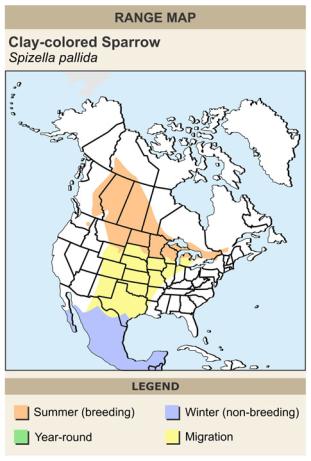
Clay-colored Sparrow Continues..

Clay-colored Sparrow (Spizella pallida)
The Clay-colored Sparrow continues at Homeless Garden in Santa Cruz, near Antonelli Pond.

It is associating with numerous White-crowned (Zonotrichia leucophrys) and Golden-crowned Sparrows (Z. atricapilla).


The following is a general range map for this species:

image by Whatbird.com

October on the Water

Yesterday, 10 October 2015, my friend and I took our last pelagic birding trip of the year.  This particular trip was out of Monterey.

I will update the official species to this post when it is made available.

The ultimate noteworthy sightings was a probable WEDGE-TAILED SHEARWATER (Puffinus pacificus).  Next in the noteworthy line was a Manx Shearwater (P. puffinus).

No photos, from me on the above two birds but I did manage a few photographs during the, grueling at times, boat trip.

This high count species is one that should be off the coast of southern California.  They must be about "drained" of Black-vented Shearwater (P. opisthomelas) because we had them in the thousands up here.

Black-vented Shearwater
In the morning the marine layer was really socked in and we plowed through the fog. This was when we had most of our Northern Fulmar (Fulmarus glacialis)


Northern Fulmar

The further we went out, the chance of albatross was better.  Yesterday's trip we had one, this Black-footed Albatross (Phoebastria nigripes).


Black-footed albatross
When you are out on Monterey Bay this time of year, you stand a good chance of seeing Humpback Whales (Megaptera novaeangliae).  Yesterday did not disappoint.


the tail and fluke of one of many Humpback Whales we encountered


Monday, October 5, 2015

It's Yellow, It's Green....

It's Yellow-green.  Vireo.

Yellow-green vireo (Vireo flavovirindis)
This rare active songbird is continuing, as of this post, at Laguna Grande Regional Park in Seaside, Monterey County.

Actively foraging during this particular encounter, the Yellow-green vireo is primarily a passerine of Central America and Mexico.

The morning marine layer, and a super quick mover successfully foraging all the while made for a poor photo opportunity.  However, most importantly it made for a delightful observation shared with Kaia.  An enjoyable time respectfully experiencing a personal intersection with this being's life.

We all find ourselves a little wayward in life from time to time.  For this vireo, it seemed to have plenty to forage on and adequate shelter to use while it finds its way through this life.
I do too, and am quite thankful for it.

This bird continued to forage along the bank-side willows across from the restrooms on Virgin Ave side of the park.
The following is a general range map for yellow-green vireo:


Monday, December 22, 2014

Kid Townsend, Newness in life.

Townsend's Warbler (Setophaga townsendi), hatch-year male
New beginnings.  For many of us.  And not really due to the new year of 2015 a week and a half away; however, it is a convenient "mile-marker."

New beginnings, for me.  Also, for this particular Townsend's Warbler (TOWA).

This individual is a "hatch(ing) year" (HY) male Townsends Warbler.  We here in the Monterey Bay region of the central California coast are fortunate to live side-by-side with them during the fall and winter months.

Very much a western warbler, it is always a welcomed flash of yellow when things get a little colder for us.  Well, cold in California terms..

TOWA spend the spring and summer breeding season in western Washington state, British Columbia and Yukon Territory Canada, and Alaska. 

Yes, we get them in migration and then many stay the winter.

Others continue on to western and central Mexico.

They are insectivores.  Active little birds, the are constantly gleaning for insects under leaves, in bark crevices, and even on the ground for very short periods of time to chase insects that drop.  For many insects, a main defense is to simply drop down..


A large part of warblers' diet are larvae from the moth Family: Geometridae.  All those "inch worms" we see; those are the caterpillars from that family of moths.

Not seeing any right now?  With all this rain we have been getting lately, just wait until Spring.  Find a foraging warbler such as this.  Then, check out the prey-item in its beak. 


Hatch-year (HY) birds simply means it hatched out this calender year.  This is its first winter.  While he is nearing his "full-adult" feather plumage status, he still has so young-bird's feathers to lose.  Superficially, his thick, broad, dark black thoat and breast band is still coming in.  He also ha some yellow remaining on what will be an all black crown.

New beginnings. 

Come 1 January 2015, this bird will have graduated from HY to After Hatch Year age status.  It will be a full-adult male Townsend's Warbler.  It will experience its first Spring and Summer way up north as an adult male bird.  And perhaps years worth of being a warbler on this world.  Newness.

New beginnings. As with this warbler,  1 January will be a symbolic marker of new beginnings in my life.  It will also be so for this 'blog, very much in its nascent stages.  Stay tuned.

New beginnings.  New explorations, both outside and within one's self. 

New growth and learning.  For me, you, and certainly for this young and rapidly-growing warbler encountered.  We are all in it together, after all.


**for further reading, and a window into part of my past, check out bigbendnature.com.  Hit up some of the archives seen on its right-hand sidebar.  It is pretty much a static blognow, there is not going to be much updating to it as I am happily living here now.  I just thought you might like to know.

We wish everyone Happy Holidays, however you spend them.